Tutorial quantriet
Quantititative Rietveld refinement
Files needed: al2o3.cif; caf2.cif; zno.cif; cpd-1d.xy; round_robin_xy.zip
Learning Outcomes: This tutorial will introduce you to quantitative Rietveld refinement. The tutorial uses data on an Al2O3/CaF2/ZnO mixture from the Round Robin where microabsorption effects are minor and there is minimal preferred orientation. See J. Appl. Cryst., 2001, 34, 409-426.
Quantitative analysis is a complex area with many pitfalls. Before doing quantitative work in anger you should read the specialist literature (e.g. Round Robin publications by Madsen/Scarlett or their chapter in Simon Billinge/Robert Dinnebier’s text). Searching the web for “Reynolds Cup” will take you to some interesting pages hosted Clay Minerals Society which describe methods for sample preparation, data collection and data analysis that are required to get accurate and precise answers.
Information: Data were collected on a diffractomer with Cu Ka1/2 radiation and a graphite monochromator. More details are available on line.
1. Download the data files and follow topas-editor menus to set up a 3 phase Rietveld refinement for data set cpd-1d.xy. Beware: the ZnO x/y parameters should be entered as fractions:
x =2/3; y =1/3;2. In each “str” section, make sure phase_name is correct and enter a line to store the weight_percent of each phase:
phase_name zno
weight_percent perc_zno 0

phase_name al2o3
weight_percent perc_al2o3  0

phase_name caf2
weight_percent perc_caf2  0
3. Perform Rietveld refinement. Try initially just refining an overall TCHZ peak shape. Try also refining size/strain contributions on the different strs without and with the TCHZ. Rwp values will be ~12.4/11.7/11.0% for the different models. Note how the refined wt % values vary between these models. They probably won’t differ by more than ~0.1%. I got values of 14.9%/52.9%/32.2%.
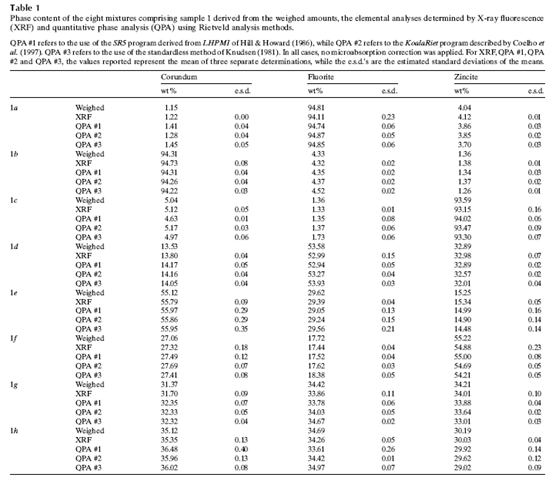
4. The results reported in the paper are 14.16/53.2/32.57%. How do your results compare?
5. Read the paper to learn about some of the things that might go wrong in Quantitative Rietveld refinement and details of all the mistakes other people made.
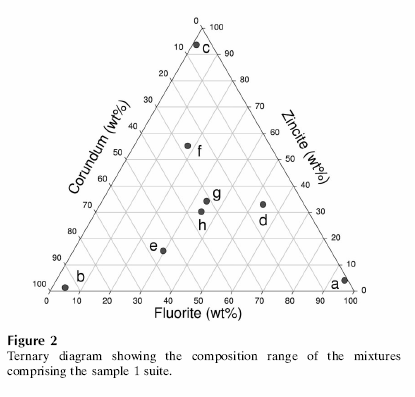
6. The file linked here is set up so that you can quickly refine all the different samples prepared for the Round Robin. It shows how you can quickly tabulate results from topas using the “out” commands. It uses the #list command which is available from topas v6 onwards. Compare your answers to those in the paper. Compositions are in the figures below which have been taken from the paper. Method qpa2 is the closest to the one you’re using here.